Our thinking

Human intelligence behind Polyworld

Our Manifesto states our position, in a page.

The papers below are its foundations: how intelligence and meaning emerge between minds, what makes expertise valuable, and what it would take for a more capable collective intelligence to stay human at its source.

Each paper stands on its own. Read together, from oldest to newest, they trace the evolution of our thinking.

The Polyworld HI Manifesto

Polyworld sees AI as a multiplier of human intelligence. The greater intelligence that results does not have to belong to a machine. It can emerge from us.

Read the manifesto Or download PDF
Our thinking

Papers

The Resolution Gradient

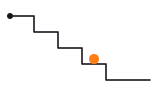
Why might learning drift into the machinery when no one intends it? Machine capability can be bought quickly, human capability has to be grown, and so each sensible local decision tilts the same way. The paper names this the resolution gradient and describes the ratchet that locks it in. It takes the question left open in Resolution, Not Revolution, where learning should live, and answers with a return path: what a system learns has to come back and change the people in it. It then asks who will pay to keep that path open.

Read the paper Or download PDF
Resolution, Not Revolution

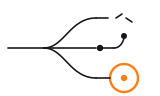
Cells became organisms, and organisms became colonies. This paper looks at how biology handled the point where interdependence outgrows what a group can manage, and asks whether people are approaching a similar point. AI could help the human network learn, or it could become the place where the network learns instead of its people. The difference lies in where learning lives, not in how much AI is used. It applies the conditions set out in HI: Axioms and the Human Continuity Hypothesis, and the argument is carried further in The Resolution Gradient.

Read the paper Or download PDF

HI: Axioms and the Human Continuity Hypothesis

The shortest paper and the architectural one. HI is intelligence that arises from humans in relationship. It sets out five conditions for HI to emerge without cutting its link to the people who make it up: human substrate, reality coupling, plurality, plasticity and answerable connection. The design rule that follows is to use AI to extend what the human network can do, not to replace the network. It gives a formal footing to the ideas in The Polyworld HI Manifesto, and builds on the account of how a “we” forms in Semantic Field Dynamics.

Read the paper Or download PDF

Gainful Compression, Significance and the Formation of We

What is expertise, and how could it reach more people without being diluted? An expert has compressed years of encounters into a few things worth noticing, and stays alert to the case that breaks the pattern. AI can compress thousands of audience encounters and bring the anomalies back to the expert, and trust lets what matters to one person start to matter to another. This is the learning loop behind a mindcast. It develops the idea of a “we” first set out in Semantic Field Dynamics, and applies the self-observation described in Learning the Next Mind to the expert.

Read the paper Or download PDF

Learning the Next Mind

The most personal paper. It starts with a simple wish to think better and describes what years of practice teach: spotting a loop while you are in it, returning faster, choosing when certainty is not on offer. It then turns to AI, which amplifies whatever habits of mind it meets, and argues that self-observation is a prerequisite for working with it well. “The path to We runs through a more autonomous I.” This extends the participation theme in The Amplification–Coherence Cycle down to the individual.

Read the paper Or download PDF

The Amplification–Coherence Cycle

Why does life with AI feel both empowering and disorienting? A three-part cycle offers an answer: amplification creates possibility, coherence keeps it viable, and participation changes the field. If intelligence is becoming abundant, the open question is what participates, and whether people stay participants or become spectators. A short essay in plain language that applies the framework of Semantic Field Dynamics to evolution, and the quickest route into the papers that follow.

Read the paper Or download PDF

Semantic Field Dynamics

The foundation paper for the later work, and the fuller treatment of the pattern proposed in The Fractal Emergence of Intelligence. Intelligence is not held inside individual minds or machines. It arises in the shared field of meaning between them. The paper traces how loose collections of parts become a “we” and then an “I”, why a system that becomes too coherent turns brittle, and why alignment between people and AI has to grow through interaction rather than be imposed from outside. It is the longest and most technical of the papers.

Read the paper Or download PDF

The Fractal Emergence of Intelligence

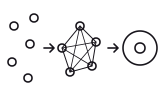
How does intelligence emerge, in cells, brains, societies and machines? The paper proposes a pattern that repeats at every scale: many units multiply, they synchronise into a shared state, and a new individual forms that becomes the unit of the next round. It argues that trust, understood as mutual predictability, is what keeps the middle step stable, and that evolution favours distributed networks over any single giant mind. It closes with testable predictions for networks of people and AI. It is the earliest of the papers, and Semantic Field Dynamics takes its pattern further.

Read the paper Or download PDF

Get early access

Polyworld mindcasts are currently in development with our first expert partners. Register your interest to follow the launch, experience early mindcasts and explore whether your own body of knowledge could become a Polyworld mindcast.

Get Early Access