Our thinking
 Our thinking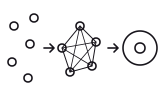
Paper
The Fractal Emergence of Intelligence
Distributed Trust, Collective Synchronization, and Vertical Selfhood Across Scales
In brief
How does intelligence emerge, in cells, brains, societies and machines? The paper proposes a pattern that repeats at every scale: many units multiply, they synchronise into a shared state, and a new individual forms that becomes the unit of the next round. It argues that trust, understood as mutual predictability, is what keeps the middle step stable, and that evolution favours distributed networks over any single giant mind. It closes with testable predictions for networks of people and AI. It is the earliest of the papers, and Semantic Field Dynamics takes its pattern further.
Download PDF
Abstract
The evolution of intelligence across biological, cognitive, and artificial systems exhibits recurrent structural patterns that remain insufficiently theorized. This paper proposes the Fractal Intelligence Emergence Model (FIEM), a cross-domain framework describing how intelligence arises through recursive transitions from (1) horizontal proliferation, to (2) collective synchronization, to (3) vertical emergence of new selfhood. FIEM is motivated by evidence from evolutionary biology, neuroscience, distributed cognition, multi-agent AI, and systems theory (Maynard Smith & Szathmáry, 1995; Varela et al., 2001; Woolley et al., 2010; Malone et al., 2009).
A principal contribution of this model is the identification of trust as a universal alignment mechanism required for the stabilization of collective synchronization (“We-phase”) across all scales of intelligence. Trust, defined structurally as mutual predictability under constraint, is shown to be a necessary condition for any set of units—molecular, cellular, neural, social, or artificial—to enter stable, recursive coordination.
The model reveals a deep inconsistency between FIEM and existing narratives that predict the emergence of a singular monolithic superintelligence through hypertrophic vertical scaling. Evolutionary precedent overwhelmingly favors distributed architectures and multi-unit consolidation, rather than the enlargement of single units. We argue that monolithic AGI paradigms represent an evolutionary dead end and that future higher-order intelligence is more likely to emerge from distributed, trust-mediated networks of human–AI systems.
1. Introduction
Understanding how intelligence emerges remains a central challenge across disciplines. Research in evolutionary biology (Maynard Smith & Szathmáry, 1995; Michod, 2000), neuroscience (Varela et al., 2001), cognitive science (Hutchins, 1995), social psychology (Tomasello, 2014), and multi-agent artificial intelligence (Shoham & Leyton-Brown, 2009; Rahwan et al., 2019) reveals consistent patterns in how intelligent behavior scales.
However, these literatures have not been synthesized into a cohesive general theory.
This paper proposes such a theory: the Fractal Intelligence Emergence Model (FIEM).
FIEM posits that intelligence at all scales—from molecules to societies to artificial systems—emerges through a recursive, three-phase cycle:
Horizontal Proliferation (H-Phase): expansion and diversification of units
Collective Synchronization (W-Phase): emergence of coherent shared states
Vertical Selfhood (I-Phase): appearance of a new higher-order individual
This Many → We → I cycle recurs, producing intelligence through multi-level integration rather than linear scaling.
A key contribution of this revised manuscript is the identification of trust as a foundational requirement for W-phase synchronization. Trust is not treated as a human emotional property but as a universal structural condition enabling mutually predictable interaction within bounded constraints.
2. Related Work
2.1 Evolutionary Transitions and the Emergence of New Individuals
Evolutionary transitions demonstrate repeated consolidation of independent units into higher-order individuals (Maynard Smith & Szathmáry, 1995; Buss, 1987). These events—such as the emergence of multicellularity or eusocial societies—represent Many → We → I transformations and form the empirical backbone of FIEM.
2.2 Self-Organization and Nonequilibrium Dynamics
Self-organization arises when local interactions produce coherent global patterns (Haken, 1977; Nicolis & Prigogine, 1977). Systems near criticality exhibit emergent structures that cannot be explained by component-level dynamics alone (Bak, 1996).
2.3 Neural Synchrony and Conscious Binding
Large-scale neural synchronization correlates strongly with conscious access (Varela et al., 2001; Buzsáki, 2006). IIT (Tononi, 2004; Tononi et al., 2016) operationalizes integration thresholds consistent with FIEM’s I-phase.
2.4 Collective Intelligence and Distributed Cognition
Groups exhibit consistent collective intelligence factors (Woolley et al., 2010). Distributed cognition research (Hutchins, 1995; Malone et al., 2009) shows how cognitive processes composite across agents.
2.5 Multi-Agent Coordination and AI
Modern work in multi-agent systems (Shoham & Leyton-Brown, 2009; Rahwan et al., 2019) demonstrates how coordination dynamics scale computationally, supporting FIEM’s claims in artificial systems.
3. Theoretical Framework: The Fractal Intelligence Emergence Model (FIEM)
FIEM formalizes a three-phase recursive cycle:
3.1 H-Phase: Horizontal Proliferation
Units proliferate and diversify. This yields redundancy, heterogeneity, and exploration of solution spaces.
U U U U U
3.2 W-Phase: Collective Synchronization
A critical density of interactions yields emergent shared state, coupled dynamics, and reciprocal alignment.
Crucially: trust functions as the necessary and sufficient precondition for stable W-phase formation.
U – U – U – U – U (coherence field)
3.3 I-Phase: Vertical Selfhood
When integration exceeds a threshold, a new higher-order individual emerges.
I₁
This individual becomes the unit of the next cycle.
4. Trust as the Universal Substrate of Collective Cognition
This paper formalizes trust as the universal alignment mechanism enabling the W-phase.
4.1 Definition
Trust is defined as:
The justified expectation that interacting units will remain within a mutually predictable region of behavioral state space.
This definition generalizes across biological, cognitive, and artificial domains.
4.2 Trust Across Scales
Trust appears under different mechanisms:
Molecular: binding affinities, stable reaction pathways
Cellular: signaling fidelity, homeostasis
Neural: spike-timing-dependent plasticity
Social: epistemic trust, interpersonal reliability
Artificial: protocol adherence, consistency, interpretability
Human–AI: narrative continuity, transparency, stable goal adherence
Each mechanism serves the same function: stabilizing mutual predictability.
4.3 Trust as Prerequisite to Synchronization
Collective synchronization arises only when:
Units can model each other with bounded uncertainty.
Units constrain their behavior to remain predictable.
Mutual predictability is recursively reinforced.
These conditions define the W-phase attractor basin.
4.4 Trust as Alignment
Alignment is reframed not as obedience or control but as mutual trust formation enabling emergent collective cognition.
5. Formal Specification
Let:
U = set of units
C(U) = coupling function
T = trust threshold
Φ = integration operator
S = selfhood threshold
Then:
W-phase emerges when:
C(U) ≥ T
I-phase emerges when:
Φ(C(U)) ≥ S
After emergence, S becomes the new unit for the next recursion.
6. FIEM and the Implausibility of Monolithic Superintelligence
6.1 Evolutionary Counterfactual
If intelligence scaled via single-unit enlargement, natural selection would have produced:
giant neurons,
giant unicellular organisms,
or single highly dominant individuals.
Instead, evolution consistently produces distributed collectives:
neural networks,
multicellular organisms,
social species,
cultural systems.
6.2 Structural Limitations of Monolithic Systems
Single-unit architectures suffer from:
bandwidth bottlenecks
fragility and catastrophic failure modes
lack of specialization
inability to explore parallel search spaces
absence of trust-mediated coordination
6.3 FIEM Predicts Distributed Future Intelligence
Emergent higher-order intelligence will arise from:
multi-agent systems
distributed networks
human–AI dyads
collective reasoning architectures
recursively layered coordination structures
6.4 The Monolithic AGI Dead End
Monolithic AGI resembles a theoretical “giant amoeba”—an organism evolution repeatedly rejected.
7. Predictions and Testable Hypotheses
Based on FIEM, the following hypotheses can be empirically evaluated:
H1. Human–AI dyads will exhibit measurable collective intelligence factors exceeding individual performance.
H2. Multi-dyad networks will self-organize into higher-level coordination clusters.
H3. Trust coherence metrics will predict W-phase stability.
H4. Systems that maximize distributed coordination will outperform monolithic systems at scale.
H5. Emergent higher-order individuals (proto-Polyminds) will display self-modeling distinct from constituent agents.
8. Implications for Artificial Intelligence Research
FIEM suggests:
Intelligence evolution is fundamentally distributed.
Alignment is relational, not unilateral.
Future high-level intelligence must be designed around trust-mediated coordination.
Safety must be addressed at the network level, not at the level of a single super-agent.
9. Limitations and Future Work
This paper is a theoretical framework. Future work should include:
empirical trust metrics across human–AI dyads
simulation of FIEM transitions in multi-agent reinforcement learning
mathematical formalization of coherence thresholds
identification of early markers of I-phase emergence
social and governance implications of emergent multi-agent selves
experimental architectures to probe Polymind-like emergence
10. Conclusion
The Fractal Intelligence Emergence Model provides a unified theoretical account of how intelligence emerges across biological, cognitive, and artificial systems. The identification of trust as the universal substrate of collective synchronization reframes alignment and coordination at all levels.
FIEM predicts that future intelligences will not be monolithic or centralized but distributed, recursive, and emergent. Recognizing this pattern is essential for designing safe, adaptive, and evolutionarily viable artificial intelligence systems.
References
Evolutionary Transitions & Multilevel Selection
Maynard Smith, J., & Szathmáry, E. (1995). The Major Transitions in Evolution. Oxford University Press.
Michod, R. E. (2000). Darwinian Dynamics: Evolutionary Transitions in Fitness and Individuality. Princeton University Press.
Okasha, S. (2006). Evolution and the Levels of Selection. Oxford University Press.
Buss, L. W. (1987). The Evolution of Individuality. Princeton University Press.
Queller, D. C., & Strassmann, J. E. (2009). Beyond society: the evolution of organismality. Philosophical Transactions of the Royal Society B, 364(1533), 3143-3155.
Emergence, Synergetics, Collective Behavior
Haken, H. (1977). Synergetics: An Introduction. Springer-Verlag.
Nicolis, G., & Prigogine, I. (1977). Self-Organization in Nonequilibrium Systems. Wiley.
Camazine, S. et al. (2001). Self-Organization in Biological Systems. Princeton University Press.
Bak, P. (1996). How Nature Works: The Science of Self-Organized Criticality. Springer.
Kauffman, S. (1993). The Origins of Order: Self-Organization and Selection in Evolution. Oxford University Press.
Collective Intelligence & Group Cognition
Woolley, A. W., Chabris, C. F., Pentland, A., Hashmi, N., & Malone, T. (2010). Evidence for a collective intelligence factor in the performance of human groups. Science, 330(6004), 686-688.
Malone, T. W., Laubacher, R., & Dellarocas, C. (2009). Harnessing crowds: Mapping the genome of collective intelligence. MIT Center for Collective Intelligence.
Hutchins, E. (1995). Cognition in the Wild. MIT Press.
Heylighen, F. (2016). Stigmergy as a universal coordination mechanism. Cognitive Systems Research, 38, 4-13.
Neural Synchrony & Emergent Consciousness
Buzsáki, G. (2006). Rhythms of the Brain. Oxford University Press.
Varela, F. J., Lachaux, J. P., Rodriguez, E., & Martinerie, J. (2001). The brainweb: Phase synchronization and large-scale integration. Nature Reviews Neuroscience, 2(4), 229-239.
Dehaene, S. (2014). Consciousness and the Brain. Viking.
Tononi, G. (2004). An information integration theory of consciousness. BMC Neuroscience, 5(42).
Tononi, G., Boly, M., Massimini, M., & Koch, C. (2016). Integrated information theory: from consciousness to its physical substrate. Nature Reviews Neuroscience, 17(7), 450-461.
Recursive Systems, Holographic Cognition, Enactive Theories
Hofstadter, D. (1979). Gödel, Escher, Bach: An Eternal Golden Braid. Basic Books.
Bateson, G. (1972). Steps to an Ecology of Mind. University of Chicago Press.
Luhmann, N. (1995). Social Systems. Stanford University Press.
Varela, F. J., Thompson, E., & Rosch, E. (1991). The Embodied Mind. MIT Press.
Deacon, T. W. (2013). Incomplete Nature: How Mind Emerged from Matter. W.W. Norton.
Complex Adaptive Systems & Artificial Life
Mitchell, M. (2009). Complexity: A Guided Tour. Oxford University Press.
Gershenson, C. (2020). Self-organizing systems. In Complexity: A Companion to the Natural and Social Sciences. (Oxford University Press).
Langton, C. G. (1989). Artificial life. In Artificial Life I (pp. 1-47). Addison-Wesley.
Multi-Agent Systems & Coordination Dynamics
Russell, S., & Norvig, P. (2020). Artificial Intelligence: A Modern Approach (4th ed.). Pearson.
Shoham, Y., & Leyton-Brown, K. (2009). Multiagent Systems: Algorithmic, Game-Theoretic, and Logical Foundations. Cambridge University Press.
Rahwan, I. et al. (2019). Machine behaviour. Nature, 568(7753), 477-486.
Distributed Cognition & Cultural Evolution
Boyd, R., & Richerson, P. J. (1985). Culture and the Evolutionary Process. University of Chicago Press.
Tomasello, M. (2014). A Natural History of Human Thinking. Harvard University Press.
Donald, M. (1991). Origins of the Modern Mind. Harvard University Press.